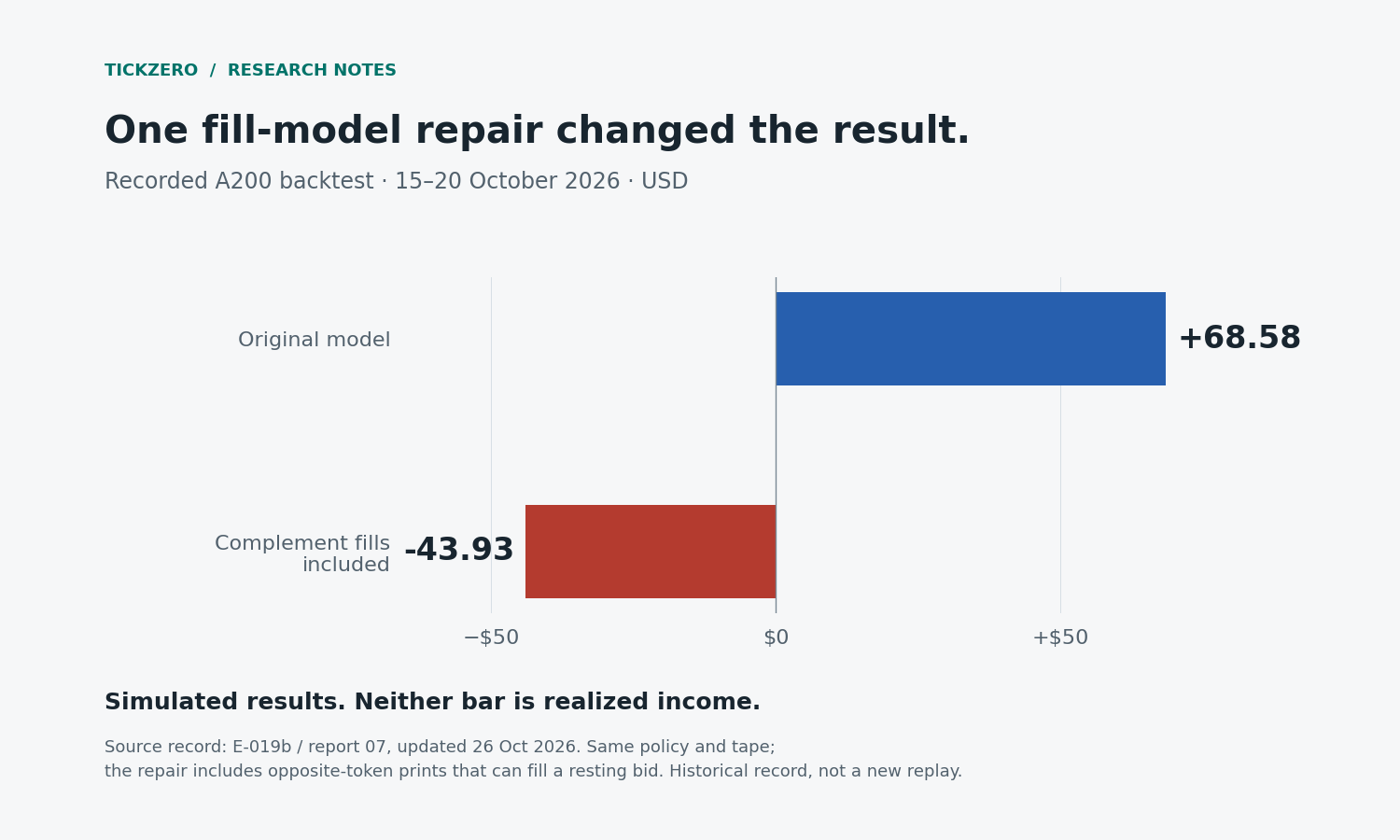
The model counted too little flow.
A200 was our paper simulator for a two-sided quoting policy. Its original fill rule looked for a trade printed on the same token as our resting bid, with a taker selling that token. That sounds plausible. In a binary outcome market, it is incomplete.
YES and NO are complementary positions. Compatible buy orders on opposite outcomes can match by creating a complete set. Polymarket’s official documentation gives the example of a YES buy at $0.60 matching a NO buy at $0.40: together they fund the $1 complete set. Official order-book mechanics.
Synthetic mechanics example
YES bid at $0.60
+ NO buy at $0.40
→ a compatible complete-set match
This is an invented price example explaining the mechanism, not a historical trade or a claim that our particular order would reach the front of the queue.
In the recorded tape model, an incoming buy printed on the NO token could therefore supply fill-eligible flow for a YES bid at the complementary price. Ignoring it excluded a path by which the bid could fill. More time sitting in the book then appeared to earn rewards with too little inventory risk.
The recorded result changed sign.
The E-019b audit used an isolated copy of the engine, the original replay payload and the same twelve policy scenarios. The repair mapped a taker BUY on token T at price p into eligible opposite-token flow at 1−p. The source record reports the following reference scenario:
| Recorded model | Simulated net |
|---|---|
| Original A200 rule | +$68.58 |
| Complement fills included | −$43.93 |
| Change | −$112.51 |
The audit record says all twelve repaired scenarios were negative. For the reference scenario it records −$56.92 of modeled trading result and $12.99 of modeled rewards, giving −$43.93 net. Those are the saved experiment’s components, not received rewards or a reconstruction of a funded account.
Changing the fill model also changed the simulated policy’s path. More fills affected inventory, exits and stops, which in turn affected time available to earn modeled rewards. This was not simply a cosmetic adjustment to the final total.
A repair is not a perfect simulator.
The corrected sign refutes that particular positive backtest under the repaired assumptions. It does not prove the market is untradeable, identify a profitable alternative or measure what a new trader could earn.
A compatible trade is still not a guaranteed fill for our order. Queue position, cancellations, size, latency, fees and subsequent exits need their own evidence. A replay can contain another bug after the first one is fixed.
The check we now put first.
- Map both outcome paths. Test same-token sells and opposite-token buys with tiny synthetic fixtures.
- Separate eligibility from allocation. A trade can reach a price without filling our queue position.
- Reconcile the policy path. Fills, exits, stops and reward accrual must refer to the same simulated sequence.
- Keep the failed result. Preserve the original rule and the repair together instead of silently replacing the green number.
The useful outcome was not a better-looking curve. It was finding that our first curve could not support the conclusion we wanted from it.
Sources and scope
- Primary internal experiment record: E-019b, dated 25 October 2026, “A200 re-run on its own tape with the I-012 fix.” Source reviewed for this article; original failed result retained.
- Primary summary: report 07, “What I recommend, in plain English,” section 2; summary updated 26 October 2026. Its A200 figures are the source of the displayed comparison. Other strategies and income estimates in that wider report are outside this article.
- Polymarket: Prices & Orderbook — compatible complementary orders and complete-set matching. Checked 28 October 2026.
- Polymarket: Positions & Tokens — complementary outcomes and complete sets. Checked 28 October 2026.
The internal records are attributed by experiment/title rather than linked to private files. Figure provenance contains the recorded values and source/figure hashes, with no raw tape, account records or local file paths.